Course Overview
This online certification course is organized into short, focused lessons. Each lesson includes video instruction, visuals, and interactive activities to help you understand, recognize, and prevent Underwater Hypoxic Blackout (UHB).
Lesson 1: Introduction to UHB
- What Underwater Hypoxic Blackout (UHB) is and why it matters
- The evolution from “Shallow Water Blackout” to “Underwater Hypoxic Blackout”
- Why experienced swimmers are often at the highest risk
Lesson 2: Science of Breath-Holding
- How oxygen and carbon dioxide affect the urge to breathe
- The role of hyperventilation and overexertion in UHB
- Why blackout can occur suddenly and without warning signs
Lesson 3: Who Breath-Holds & Why
- Swimmers, triathletes, freedivers, military trainees, artistic swimmers, and more
- Common reasons people practice breath-holding
- How motivation, confidence, and competition can increase risk
Lesson 4: History of Breath-Holding
- Ancient breath-holding: Assyrian soldiers, Greek divers, and Ama divers
- Shallow Water Blackout in Navy and free-diving history
- How modern training and hypoxic drills changed the risk landscape
Lesson 5: Types of Breath-Holding Practices
- Limited breath-holding during instruction and skill progressions
- Restricted breathing sets and “every 3, 5, or 7 strokes” drills
- Extreme hypoxic training and long breath-holding contests
- Which practices can be made safer and which should be avoided
Lesson 6: Risks & Real-World Cases
- What happens when someone passes out underwater
- How UHB leads to drowning even in strong swimmers
- Case examples of breath-holding incidents and tragedies
- Genetic and medical factors that can increase risk
Lesson 7: Prevention for Facilities & Coaches
- Developing clear rules and protocols around breath-holding
- Effective signage and communication with patrons
- How to train staff to recognize and stop dangerous behaviors
- Balancing skill development with safety and risk reduction
Lesson 8: Safer Practices for Swimmers & Athletes
- Safer ways to build comfort and confidence underwater
- Guidelines for rest, supervision, and time limits
- How to talk with swimmers, parents, and teams about UHB
Lesson 9: Responding to Incidents & Moving Forward
- Immediate actions if a swimmer loses consciousness underwater
- Why early intervention and vigilance are critical
- Reporting incidents and learning from near-misses
- How to support broader UHB awareness and prevention efforts
By the end of this course, you will understand the causes of Underwater Hypoxic Blackout, how to recognize and prevent dangerous breath-holding practices, and how to create safer training and recreational
environments for swimmers of all ages.
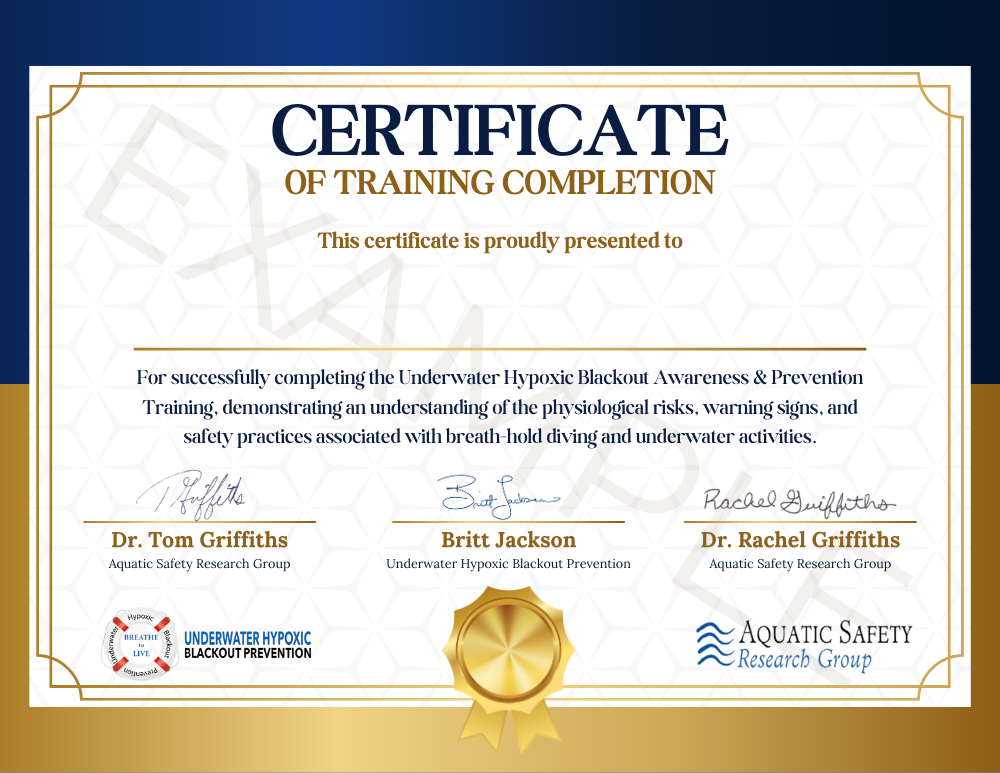
Upon successful completion of the training, you will receive a Certificate of Training Completion recognizing your understanding of the physiological risks, warning signs, and safety practices associated with breath-hold diving and underwater activities. This certificate will be issued digitally and can be downloaded, saved, or shared for professional records, in-service training documentation, or personal reference.